

When Commercial Kitchen Appliance Repair Can’t Wait
When commercial kitchen appliance repair becomes urgent, every minute of downtime costs real money. Here’s what you need to know right away:
How to find reliable commercial kitchen appliance repair:
- Look for certified technicians — CFESA certification and EPA Section 608 are the key credentials to verify.
- Confirm emergency availability — Top services offer 24/7 response, with the best arriving within 2–4 hours.
- Ask about parts — Reliable providers stock OEM parts on their service vehicles for a faster first-visit fix.
- Check warranty terms — Industry-standard coverage is 90 days on both parts and labor.
- Choose experience — Technicians with deep commercial equipment knowledge diagnose faster and fix right the first time.
A failed walk-in cooler at 11 PM or an oven breakdown mid-service rush isn’t just an inconvenience — it’s a direct hit to your revenue, your food inventory, and your customers’ trust. For restaurants, hotels, schools, and other food service operations, functioning kitchen equipment is, quite literally, the difference between profit and loss on any given day.
I’m Vasyl Turetsky, founder of iFix Appliances, with extensive hands-on experience diagnosing and repairing major commercial and household appliances across the Raleigh area — including the ovens, refrigerators, dishwashers, and ice makers that commercial kitchen appliance repair calls demand most. In the sections below, I’ll walk you through everything you need to make the smartest repair decision for your kitchen.
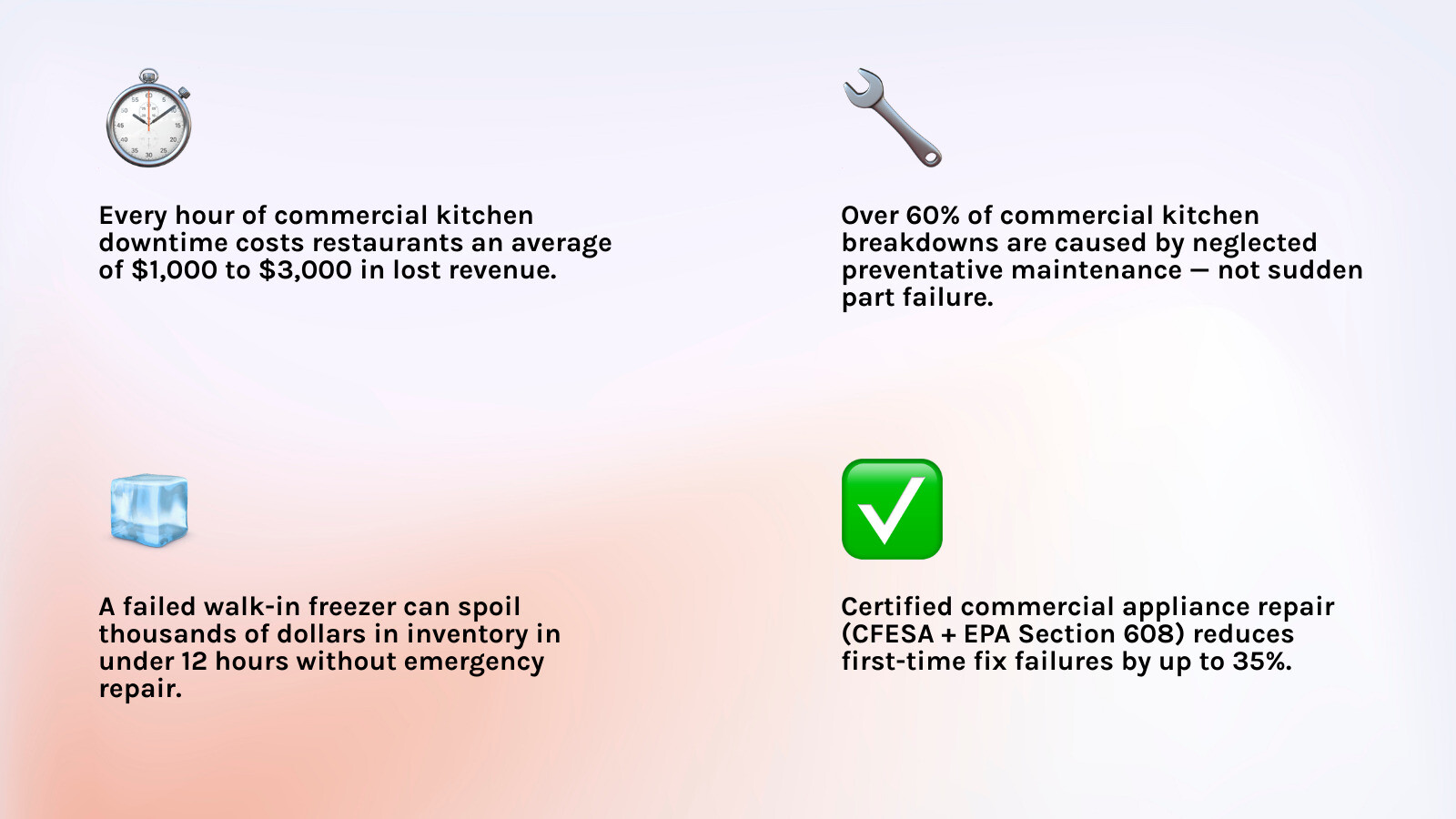
Understanding the Scope of Commercial Kitchen Equipment Services
Managing a professional food service operation in the Triangle Area means balancing a massive variety of specialized machinery. Unlike residential kitchens, where a broken range is a minor inconvenience, a commercial kitchen relies on heavy-duty, high-volume systems that must comply with strict local health department regulations.
When you seek professional support, you need a service team capable of handling both the “hot side” and the “cold side” of your kitchen, along with the sanitation systems that keep you compliant.
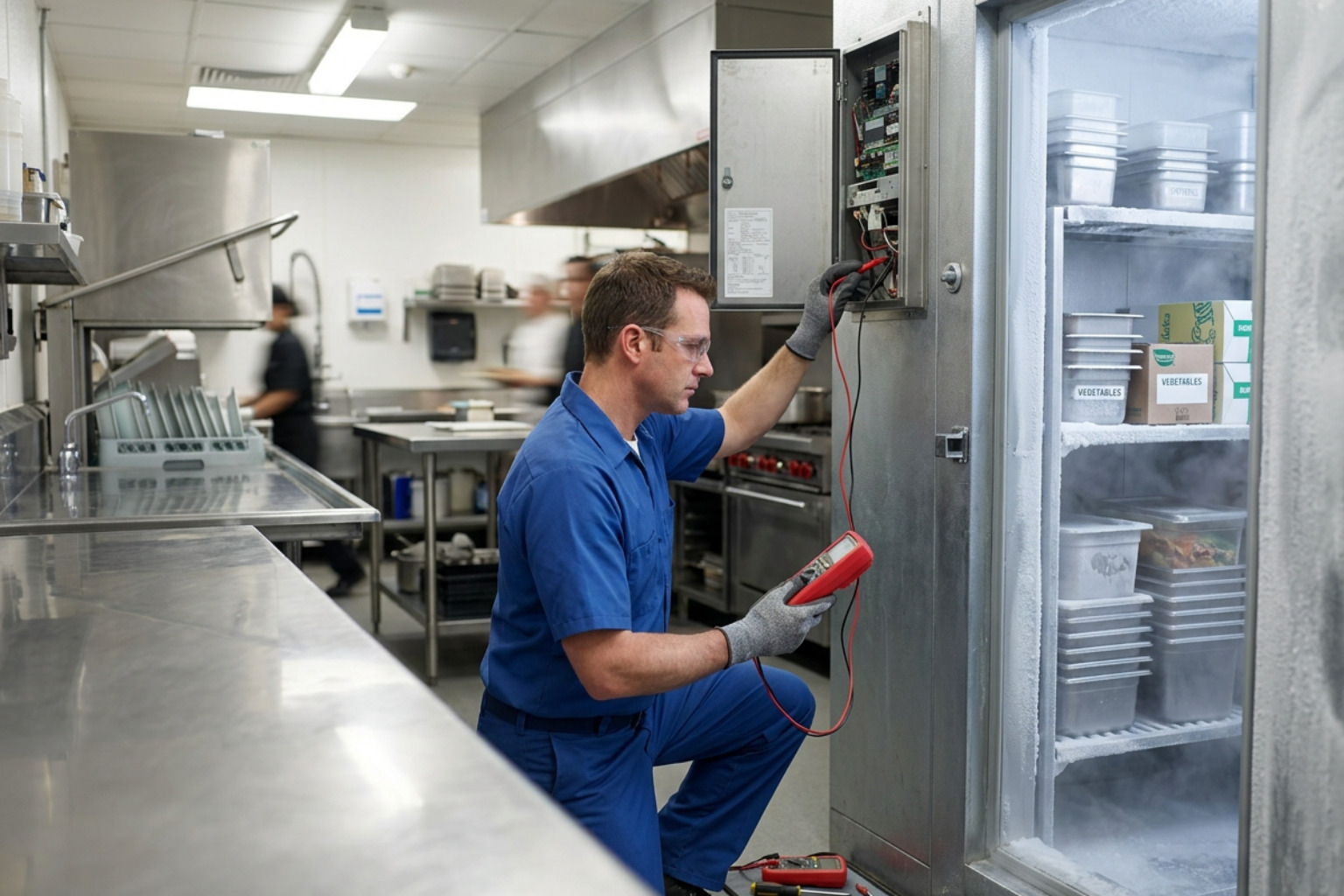
Commercial kitchen equipment services typically cover several core categories:
- Commercial Refrigeration Systems: This includes walk-in coolers, walk-in freezers, reach-in refrigerators, prep tables, and blast chillers. Because refrigeration failures can lead to immediate food spoilage and health code violations, these units require rapid, expert intervention. To understand how critical these units are, read our guide on The Commercial Kitchen’s Lifeline: Catering Fridge Repairs Explained.
- Commercial Cooking Equipment: From convection ovens, combi ovens, and deck pizza ovens to gas ranges, deep fryers, griddles, and broilers. These systems must maintain precise temperature calibrations to ensure food quality and safety. For a deeper dive into these systems, check out our Commercial Cooking Equipment Repair Guide for Busy Restaurant Owners.
- Ware-Washing and Sanitation Systems: High-temperature and chemical-sanitizing commercial dishwashers and glasswashers must maintain exact heat and sanitizing standards to meet local health codes.
- Commercial Ice Machines: Ice makers require routine cleaning, descaling, and precise water filtration management to stay operational and sanitary.
- Specialty and Mobile Kitchen Equipment: This includes food trucks, mobile kitchens, espresso machines, soft-serve dispensers, and water filtration systems.
We serve a highly diverse set of industries across North Carolina. Whether you operate a high-volume restaurant in downtown Raleigh, a hotel kitchen in Cary, a public school cafeteria in Durham, or a food truck in Wake Forest, keeping these systems running is non-negotiable.
Common Issues That Lead to Commercial Kitchen Equipment Breakdowns
In our years of servicing kitchens in Apex, Garner, and Morrisville, we have found that most emergency service calls stem from a few predictable issues. Commercial appliances are subjected to intense, daily wear and tear. When minor operational shifts are ignored, they quickly escalate into major, expensive breakdowns.
To help you identify where your risks lie, we have compiled a comparison of the most common issues found on both the hot and cold sides of commercial kitchens:
| Equipment Side | Common Component Failure | Primary Symptoms | Root Cause |
|---|---|---|---|
| Hot Side (Ovens, Ranges, Fryers) | Thermostats & Thermocouples | Uneven cooking, failure to heat, fluctuating temperatures | Wear and tear, lack of regular calibration |
| Hot Side (Gas Appliances) | Burners & Pilot Assemblies | Weak flames, yellow flames, pilot light constantly going out | Grease buildup, clogged gas orifices |
| Cold Side (Refrigerators, Freezers) | Condenser & Evaporator Coils | Unit running constantly, temperature rising | Dust, grease accumulation blocking airflow |
| Cold Side (Refrigerators, Freezers) | Door Gaskets & Seals | Frost buildup, warm spots inside the cabinet | Torn, brittle, or dirty gaskets letting warm air in |
| Ware-washing (Dishwashers) | Heating Elements & Pumps | Dishes not drying, failing to reach sanitizing temperatures | Limescale buildup, electrical short circuits |
| Ice Machines | Water Inlet Valves & Evaporators | Slow ice production, cloudy ice, freeze-ups | Mineral scaling, clogged water filters |
On the hot side, gas line problems and electrical faults are particularly dangerous. If your range is heating unevenly or your burners are failing to ignite, it is crucial to seek professional diagnostic support. You can read more about resolving these issues in our detailed guides on Oven Stove Repair and Range Repair.
On the cold side, neglected condenser coils are the number one killer of compressor motors. When grease and dust coat the coils, the compressor has to work twice as hard to reject heat, leading to premature motor failure and massive energy bills.
How to Choose the Right Commercial Kitchen Appliance Repair Service
When an appliance goes down, you do not have time to scroll through endless search results and hope for the best. You need a systematic way to vet local service providers quickly.
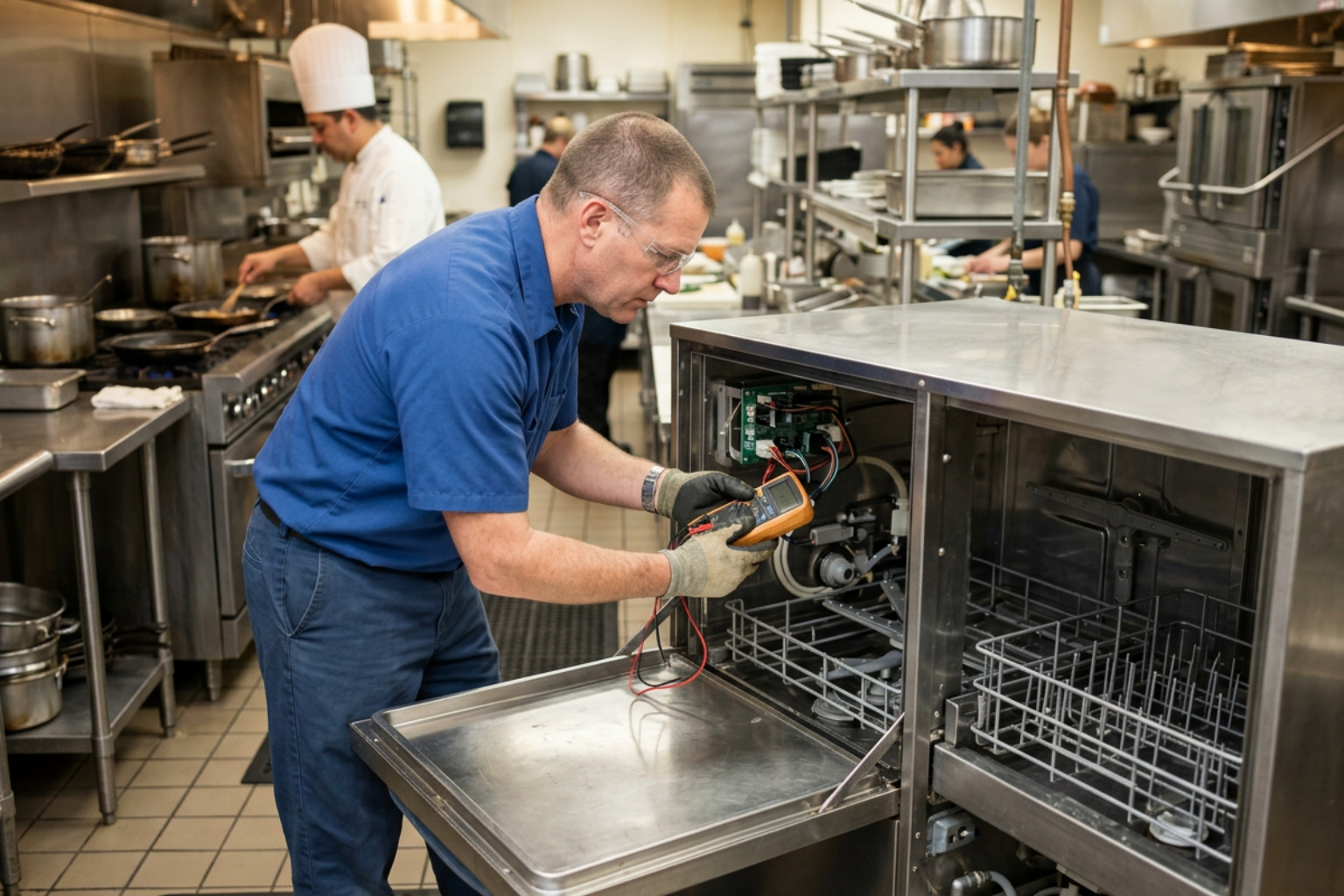
To protect your business, always evaluate a repair service using these five essential criteria:
- Response Time and Emergency Coverage: Do they offer true 24/7 emergency service? A company that cannot get to your chapel Hill restaurant until the following Tuesday is of no use when your walk-in cooler fails on a Friday night.
- Technician Certifications: Ensure the technicians sent to your facility hold verified industry credentials.
- Warranty and Guarantees: A reputable company stands behind its work. Look for providers that offer clear warranties on both replacement parts and labor.
- OEM Parts Inventory: Ask if the company prioritizes Original Equipment Manufacturer (OEM) parts or relies on cheap, generic aftermarket components.
- Local Knowledge and Reputation: Choose a company with deep roots in your specific geographic area, such as the Triangle Area, NC.
For a step-by-step framework on selecting a provider, read our guide on 5 Ways to Find Local Commercial Appliance Repair Like a Pro.
The Importance of Certified Commercial Kitchen Appliance Repair Technicians
You should never let an uncertified general handyman work on high-end commercial appliances. Modern commercial kitchen equipment is highly complex, utilizing advanced electronics, high-voltage electrical circuits, natural gas systems, and specialized refrigeration chemistry.
There are two primary certifications you must look for:
- CFESA Certification: The Commercial Food Equipment Service Association (CFESA) is the gold standard of our industry. A CFESA-certified technician has undergone rigorous training and testing in gas, electric, steam, and refrigeration systems. Hiring a CFESA-certified technician ensures your equipment is repaired to exact factory specifications.
- EPA Section 608 Certification: Required by federal law under EPA Section 608 for any technician who maintains, services, repairs, or disposes of equipment that could release ozone-depleting refrigerants. This is absolutely mandatory for anyone touching your walk-in freezers, prep coolers, or ice machines.
Using certified technicians ensures your repairs are safe, compliant with local building and health codes, and performed in a way that protects your staff and guests.
Sourcing OEM Parts for Commercial Kitchen Appliance Repair
It can be tempting to save a few dollars by choosing generic, aftermarket replacement parts. However, in a commercial kitchen, this is almost always a costly mistake.
Original Equipment Manufacturer (OEM) parts are designed and engineered specifically for your exact appliance model. Here is why they are essential:
- Preserving Factory Warranties: Using non-OEM parts can instantly void any active manufacturer warranties on your expensive commercial equipment.
- Safety and Compliance: OEM parts are built to meet strict safety standards. Generic parts may not handle the high temperatures or intense electrical loads of a commercial kitchen, creating fire or gas leak hazards.
- Durability and Performance: OEM parts simply last longer. A generic water valve or heating element might fail within a few weeks of heavy use, resulting in another round of service fees and operational downtime.
Whether you need a replacement motor for a commercial mixer or a new thermostat for a range, always insist on genuine OEM parts to maintain the integrity of your machinery.
The Strategic Choice: Repairing vs. Replacing Failing Appliances
One of the most challenging decisions a restaurant owner in Cary or Durham has to make is deciding when to stop pouring money into an aging appliance and finally replace it.
To make a business-smart decision, we recommend using the 50% Rule of Appliance Repair. If the cost of a single repair exceeds 50% of the cost of buying a new, comparable unit, replacement is usually the wiser financial choice.
However, you must also consider several other critical factors:
- Equipment Age and Lifespan: Most commercial refrigeration units last 10 to 15 years, while heavy-duty ranges can last 15 to 20 years if properly maintained. If your unit is near the end of its expected lifespan, a repair is often just a temporary band-aid.
- Repair History: Is this the first time the appliance has failed, or are you calling a technician every month? A history of frequent breakdowns is a clear sign of systemic wear.
- Energy Efficiency: Older appliances consume significantly more water and electricity than modern, Energy Star-rated models. Upgrading can dramatically lower your monthly utility bills.
- Total Cost of Ownership: Factor in the cost of lost business, ruined inventory from repeated failures, and the stress of unexpected downtime.
For example, a high-temperature commercial dishwasher is a massive investment. If the wash pump fails on an older machine, the cost of the pump plus labor might approach the price of a newer, more efficient model. For more insights on evaluating these systems, read our dedicated resource on Dishwasher Repair.
Maximizing Lifespan and Efficiency with Planned Preventative Maintenance
The most successful food service businesses do not wait for things to break. They implement a strict, proactive maintenance strategy. According to industry data, a planned preventative maintenance (PM) program can extend the operational life of your kitchen equipment by up to 40% while preventing costly, unexpected emergency breakdowns during peak business hours.
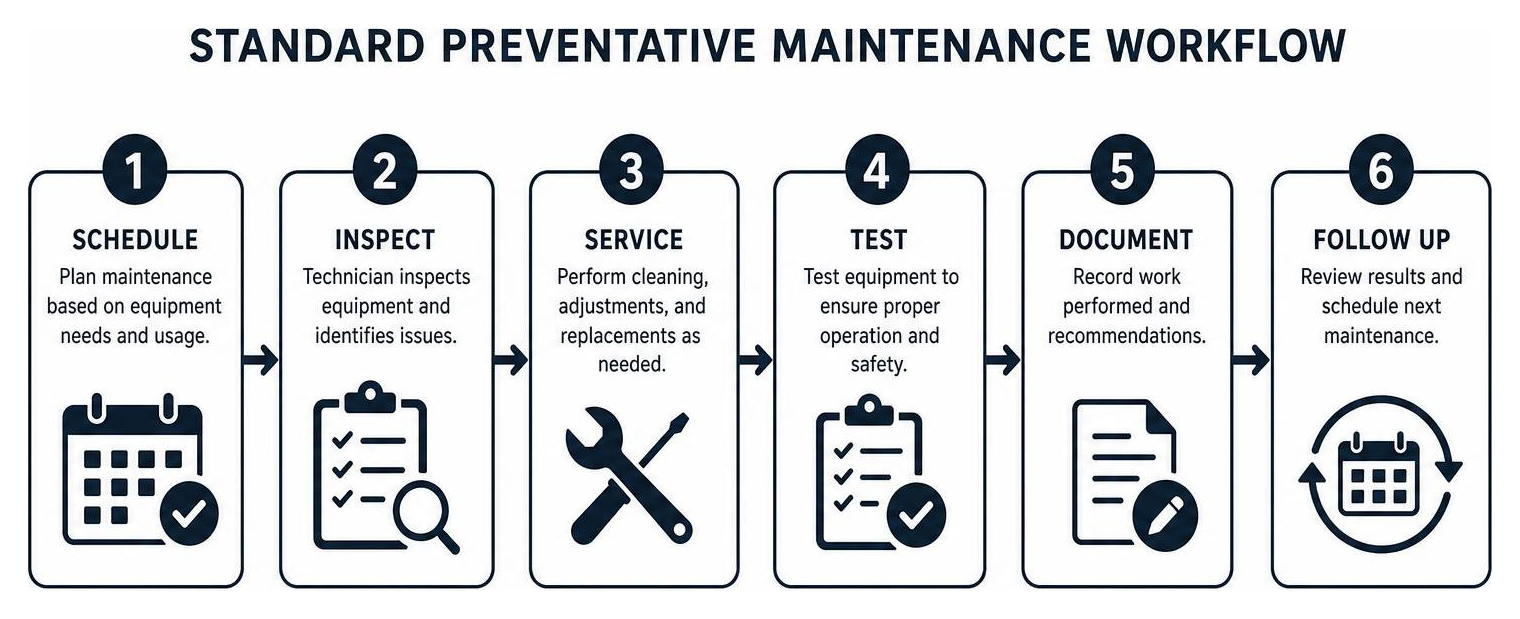
To keep your kitchen running at peak efficiency, establish a maintenance routine that includes both daily staff tasks and professional monthly check-ups:
Daily Maintenance Tasks (To Be Completed by Kitchen Staff)
- Wipe down door gaskets on all reach-in and walk-in coolers to prevent mold and air leaks.
- Clean fry pots and skim oil to prevent grease buildup on heating elements.
- Wipe down range tops and clean spill trays to keep gas burners clear.
- Empty and clean commercial dishwasher scrap baskets and spray arms.
Monthly and Quarterly Maintenance Tasks (To Be Completed by a Certified Technician)
- Deep clean and chemically descale ice machine evaporators and water lines.
- Clean and blow out condenser and evaporator coils on all refrigeration units. For more details on protecting your cooling systems, refer to our guides on Refrigerator Repair and Freezer Repair.
- Calibrate thermostats on ovens, ranges, and griddles to ensure temperature accuracy.
- Inspect gas connections, check electrical wiring for wear, and tighten loose components.
- Check refrigeration lines for refrigerant leaks and verify proper charge levels.
In addition to extending equipment life, regular maintenance directly improves energy efficiency. In some regions, specialized testing like blower door testing is used to ensure building envelopes and commercial kitchens remain energy efficient.
Keeping your equipment in top shape ensures consistent food quality, keeps your utility bills low, and boosts employee morale by providing a functional, stress-free work environment.
Frequently Asked Questions about Commercial Kitchen Repairs
How quickly can a repair service respond to an emergency breakdown?
In the commercial food service industry, response time is everything. Top-tier commercial appliance repair services typically offer a 2 to 4-hour response window for critical emergencies, operating 24 hours a day, 7 days a week, 365 days a year.
This rapid response is vital for protecting your food inventory from spoilage during a walk-in cooler or freezer failure. Ice machines also require quick attention to prevent operational bottlenecks; you can learn more about managing these critical units in our guide to Ice Maker Repair.
Do commercial repair services offer installation and parts sales?
Yes. Full-service commercial kitchen repair companies handle the entire lifecycle of your equipment. This includes performing a complete site inspection, verifying factory warranties, and providing professional, code-compliant installation of new cooking and refrigeration systems.
They also offer direct OEM parts sales to businesses that prefer to have their in-house maintenance staff handle minor repairs. To see the wide variety of systems we work with, take a look at the commercial Brands we service.
What warranties or guarantees are typically offered on commercial repair work?
A reliable industry standard for commercial repair work is a 90-day guarantee covering both parts and labor. However, depending on the specific provider and the components replaced, you may find parts warranties extending up to 1 year, and labor guarantees ranging from 30 days to 2 years.
Always ask for a detailed, upfront quote with complete cost breakdowns of materials and labor before work begins. If you are experiencing an equipment issue right now and need to discuss warranty terms or schedule a diagnostic visit, please visit our Contact page.
Conclusion
A successful commercial kitchen relies on the seamless operation of highly specialized appliances. When a system fails, having a trusted, certified, and rapid-response repair partner is the key to minimizing downtime and protecting your bottom line.
At iFix Appliances, we are proud to provide expert appliance repair services throughout the Triangle Area, including Raleigh, Cary, Apex, Garner, Durham, Morrisville, Wake Forest, Chapel Hill, Holly Springs, and Fuquay-Varina. We bring years of hands-on technical expertise, transparent pricing, and a commitment to long-term repair solutions to every commercial kitchen we serve.
Do not wait for a minor issue to turn into an expensive kitchen shutdown. To learn more about how we can support your business, or to schedule a professional service call today, visit our Commercial Appliance Repair page.
0 Comments