
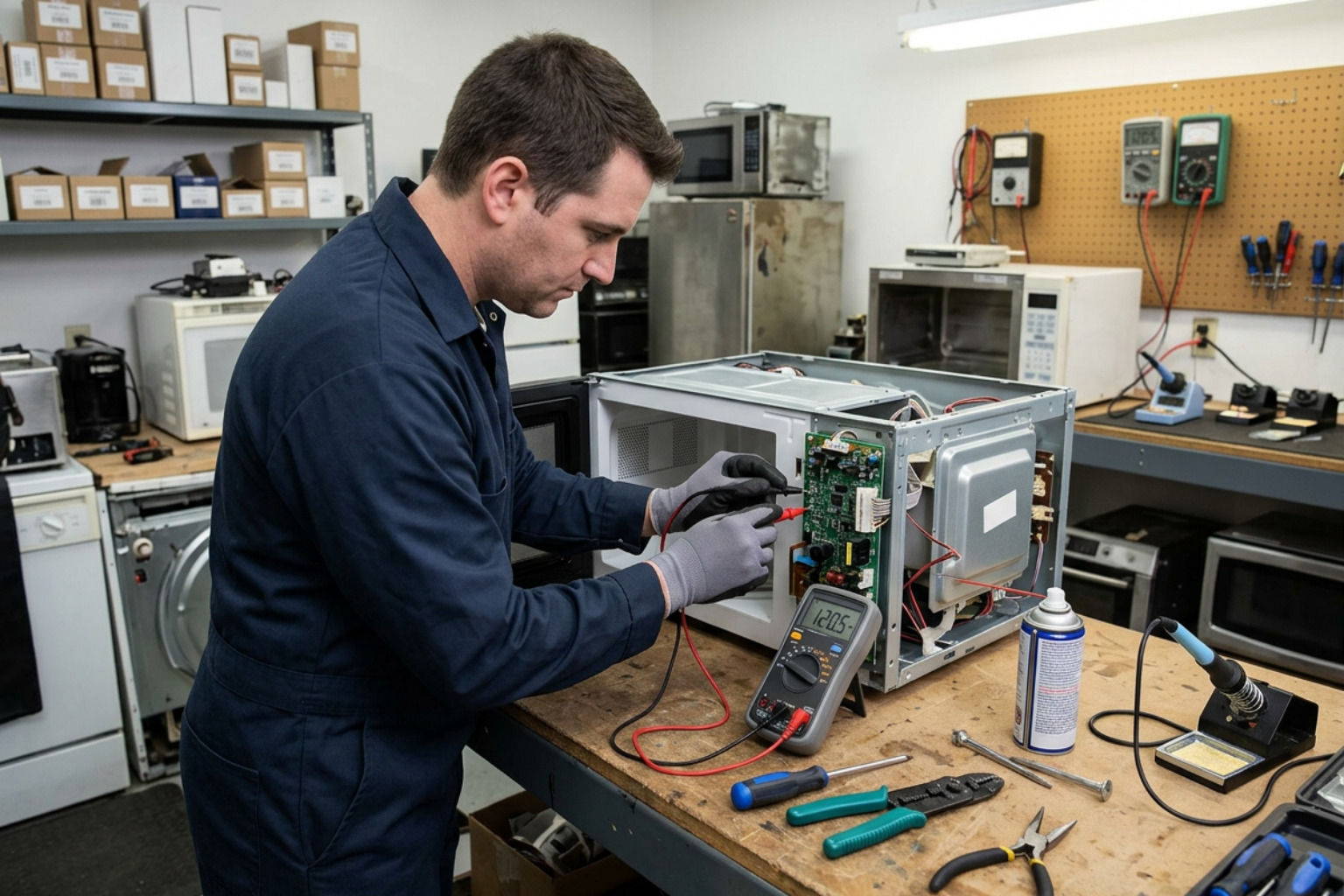
Common Cooking Appliance Issues and Microwave Repair Cary NC Solutions
Professional microwave repair Cary NC solutions typically resolve core electrical and mechanical component failures, including burned-out magnetrons, malfunctioning door interlock switches, blown thermal fuses, defective control boards, and broken heating elements. Identifying whether a breakdown stems from a failed high-voltage component or a worn door latch allows technicians to restore cooking performance safely and quickly without requiring a full appliance replacement.
Microwaves and cooking appliances rely on a balance of high-voltage components, thermal protection, and delicate electronic controls. Here are the most frequent culprits behind sudden appliance breakdowns:
- Magnetron Failure: In a microwave, the magnetron generates the microwave frequencies that heat water molecules in your food. If the microwave hums loudly, runs normally, but leaves your meal stone-cold, a burned-out magnetron or diode is usually to blame.
- Failed Door Switches: Modern microwaves use a primary, secondary, and monitor interlock switch assembly. If even one microswitch misaligns or fails internally, the unit will refuse to start, or it may instantly blow an internal fuse the second you open or close the door.
- Blown Thermal Fuses and Cutoffs: Cooking appliances generate massive amounts of heat. Thermal cutoff switches protect your cabinetry from dangerous overheating. If an internal cooling fan stops or airflow gets blocked, the thermal fuse trips permanently to cut all electrical power to the system.
- Defective Control Boards: The main printed circuit board (PCB) manages timers, relays, sensor cycles, and display readouts. Power surges or age-related solder joint failures can cause the control board to freeze, show cryptic error codes, or fail to energize heating circuits.
- Burnt Heating Elements: Electric ovens and radiant cooktops rely on heavy-gauge resistive wire encased in protective metal sheaths. Over time, metal fatigue and thermal cycling cause these elements to blister, split, and break the electrical circuit.
When tackling complex electronic failures, understanding dedicated Appliance Repair diagnostics helps pinpoint whether a sensor, relay, or wiring harness is causing intermittent faults.
Troubleshooting Ovens and Stoves That Fail to Heat
Ovens and ranges share many underlying diagnostic principles with microwaves. When your oven or stove fails to reach the proper temperature, I recommend looking at these specific subsystems:
- Gas Oven Igniter Wear: Gas ovens rely on a silicon carbide or silicon nitride igniter that must draw a precise electrical current (typically 3.2 to 3.6 amps) to open the safety gas valve. A weak igniter may glow bright orange but fail to pull enough amperage to open the valve, resulting in an oven that never lights.
- Broken Bake and Broil Elements: Inspect the bake element at the bottom of an electric oven. If you see bright spots, blistering, or visible separations along the metal coil, the element has burned out and requires replacement.
- Surface Burner Infinite Switches: If an electric stovetop burner stays stuck on high heat or does not turn on at all, the infinite rotary switch behind the control knob has likely suffered internal contact pitting.
- Out-of-Calibration Temperature Sensors: The oven temperature sensor (RTD probe) changes its electrical resistance as the oven cavity heats up. If the sensor drifts out of specification, your baking temperatures can swing wildly by 50 degrees or more.
- Burner Spark Modules: On gas stovetops, continuous clicking or the absence of a spark usually points to a failed spark electrode, moisture in the switch harness, or a burned-out spark re-ignition module.
Simple DIY Troubleshooting and Microwave Repair Cary NC Guidance
Before assuming the worst about your cooking appliances, there are several straightforward, non-invasive troubleshooting steps you can perform safely without opening any internal panels.
- Test the Power Source: Plug a small lamp or hair dryer into the wall receptacle to verify the outlet supplies steady voltage. Check your home’s main electrical service panel to ensure a circuit breaker has not partially tripped.
- Inspect and Clean the Turntable Assembly: If your microwave makes grinding noises or shudders during rotation, remove the glass tray and support ring. Clean away dried food debris, inspect the roller wheels for flat spots, and ensure the central drive bushing engages properly with the motor shaft.
- Perform a Hard Power Reset: Microprocessor glitches occasionally lock up modern digital control panels. Unplug the microwave or switch off the dedicated circuit breaker for 10 full minutes to discharge residual logic board memory before restoring power.
- Clean the Door Interlock Latches: Grease and grime can prevent the mechanical door hooks from fully depressing the internal switches. Wipe down the latch hooks and surrounding frame with a damp cloth. For simple mechanical latch fixes, check out this guide on One Simple Way to Fix Your Microwave Quickly.
Critical Safety Precautions Before Attempting Cooking Appliance Repairs
I cannot emphasize this enough: never attempt to open a microwave’s outer metal casing unless you are a professionally trained, certified technician.
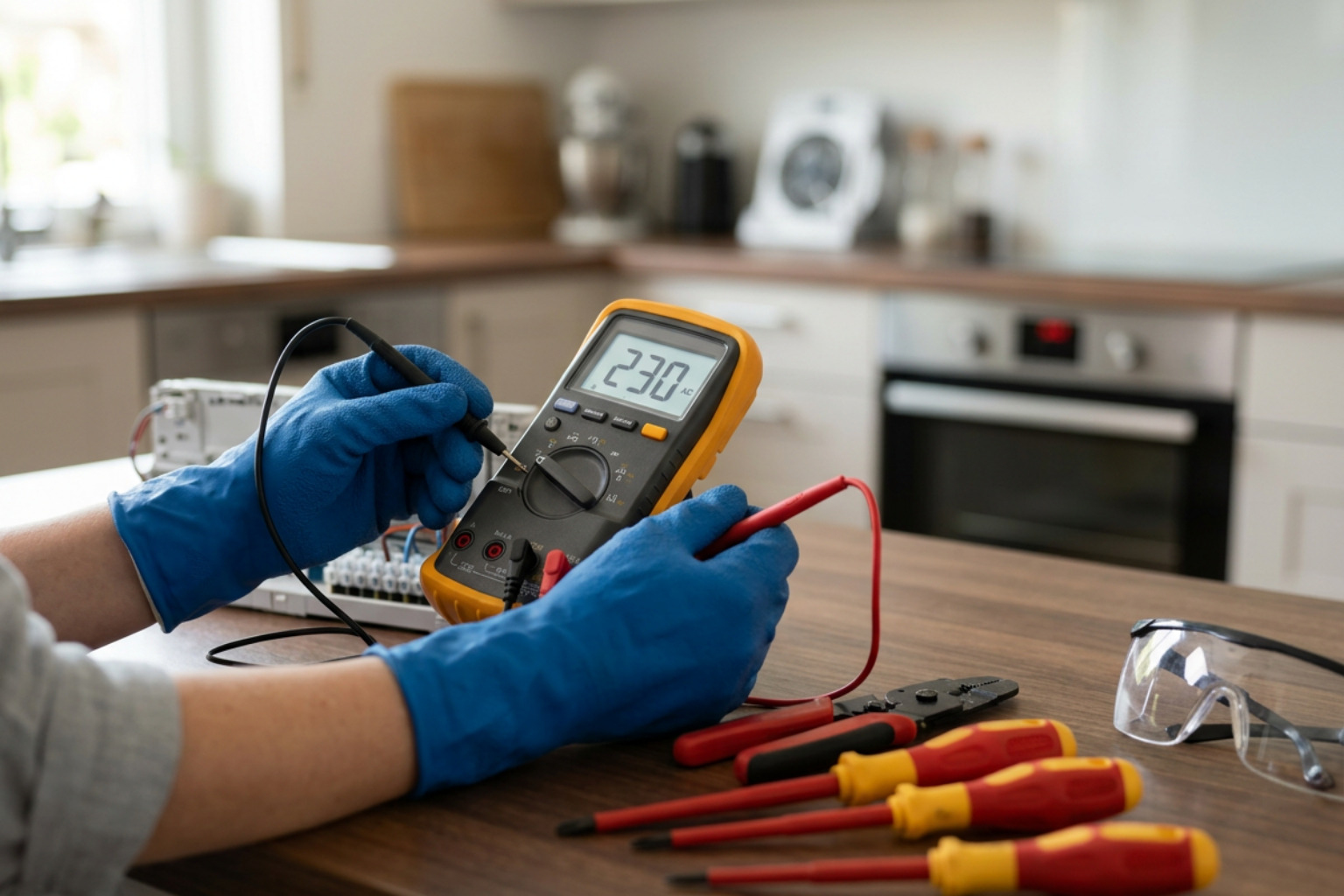
Unlike standard small appliances like toasters or blenders, a microwave contains a specialized high-voltage circuit consisting of a step-up transformer, high-voltage diode, and a massive high-voltage capacitor.
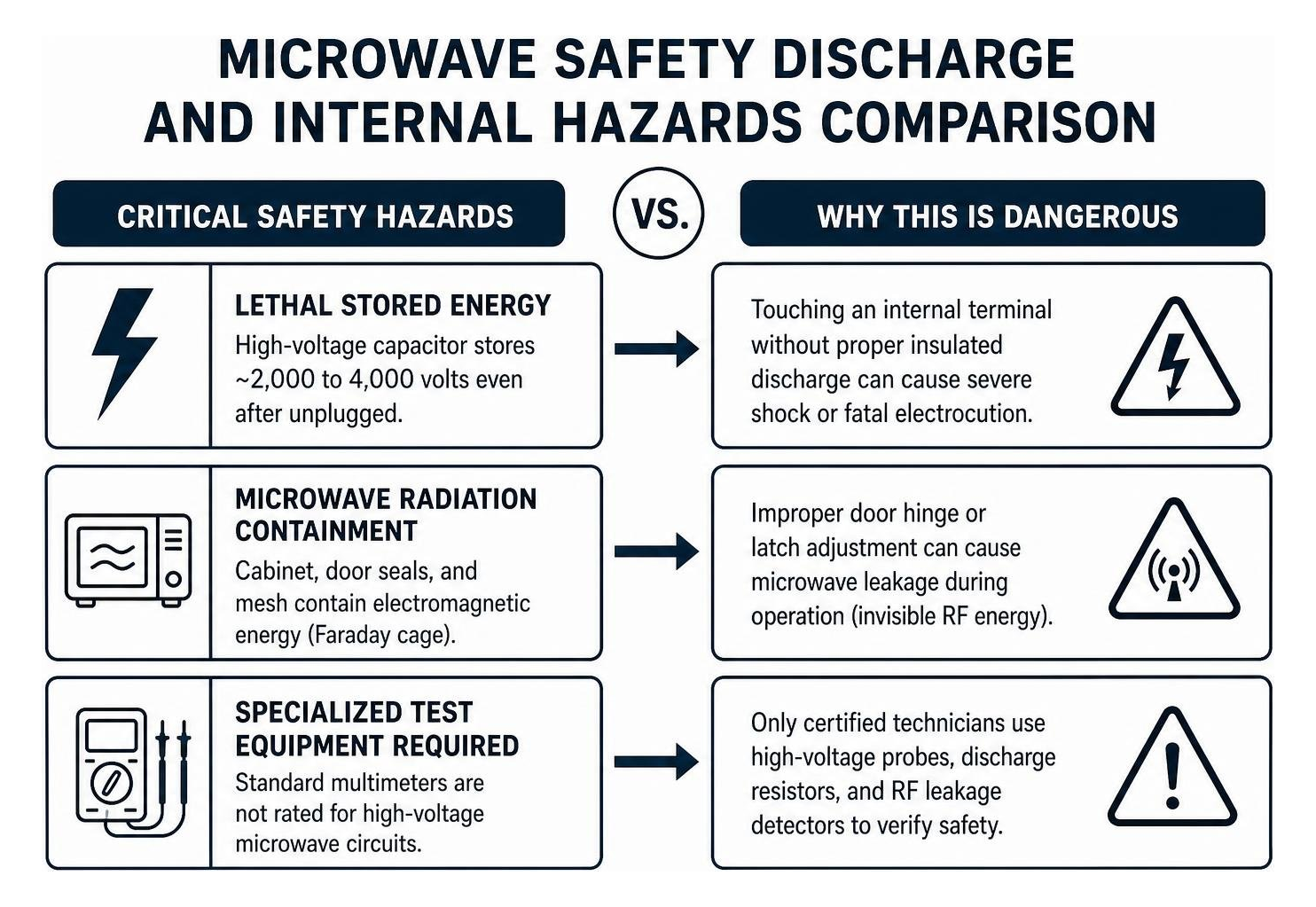
Here is why internal microwave repairs carry severe safety hazards:
- Lethal Stored Energy: The high-voltage capacitor converts household 120-volt current into roughly 2,000 to 4,000 volts to drive the magnetron. This capacitor retains this lethal electrical charge long after the unit has been unplugged from the wall. Touching an internal terminal without performing a proper, insulated discharge procedure can cause severe electric shock or fatal electrocution.
- Microwave Radiation Containment: The outer cabinet, door choke seals, and viewing mesh act as a Faraday cage designed to contain electromagnetic energy. If the door hinges or latch mechanisms are improperly adjusted during a DIY repair, the microwave can leak invisible RF radiation during operation.
- Specialized Test Equipment Requirements: Standard consumer multimeters are not rated to measure microwave high-voltage circuits. Certified technicians utilize high-voltage probes, specialized discharge resistors, and RF leakage detectors to verify unit safety.
If you are experiencing latch or interlock issues, read our detailed safety breakdown on Microwave Repair to understand how internal safety switches isolate hazardous current.
Repair vs. Replace: Making the Right Decision for Cary Homeowners
Deciding whether to repair an aging cooking appliance or invest in a brand-new unit comes down to three factors: the age of the appliance, the style of installation, and the total estimated cost of repair.
I always recommend applying the 50 Percent Rule: If an appliance has completed more than 50% of its expected useful lifespan and the total repair estimate exceeds 50% of the cost of a comparable new unit, replacement is often the more economical choice.
| Appliance Type | Average Lifespan | Typical Repair Cost | Replacement Cost (Standard to Premium) | Recommendation Guideline |
|---|---|---|---|---|
| Countertop Microwave | 6–8 Years | $90 – $160 | $80 – $220 | Replace if repair exceeds $100 or unit is over 5 years old. |
| Over-the-Range (OTR) Microwave | 8–10 Years | $130 – $260 | $300 – $850+ | Repair if unit is under 7 years old to avoid installation/cabinetry labor. |
| Built-In Microwave / Speed Oven | 10–12 Years | $180 – $380 | $800 – $2,500+ | Repair strongly recommended due to high replacement and custom trim costs. |
| Electric/Gas Freestanding Range | 13–15 Years | $150 – $320 | $650 – $1,800 | Repair if structural chassis and cooktop glass are intact. |
| Built-In Wall Oven | 12–16 Years | $180 – $420 | $1,200 – $3,500+ | Repair almost always preferred to preserve custom cabinetry dimensions. |
Countertop microwaves are mass-produced commodities; basic models are often cheaper to replace than the cost of diagnostic labor and replacement components. However, over-the-range (OTR) models, integrated microwave-convection combos, and built-in wall units involve dedicated ventilation ducting, electrical hardwiring, and custom cabinetry trim kits. For these units, professional repair saves hundreds of dollars compared to the expense of purchasing, refitting, and reinstalling a new appliance.
What to Expect: Timelines, Costs, and Warranties in Cary
When you hire a local repair specialist in Cary, NC, transparent communication and predictable pricing should be standard.

A professional repair service should always follow a structured process:
- Comprehensive On-Site Diagnostics: The technician performs electrical safety checks, tests components with precision meters, and pinpoints the root cause of the failure.
- Upfront, Itemized Quote: You receive a clear estimate detailing necessary replacement parts and associated labor rates before any repair work starts.
- Clean, Efficient Component Installation: Most standard repairs (such as replacing igniters, thermal switches, door latches, or bake elements) take between 45 to 90 minutes once parts are on hand.
- Operational and Safety Verification: The technician tests the appliance through full heating cycles and checks door seals for electrical and thermal integrity.
Standard Repair Warranty Protections
A reliable repair company stands behind its craftsmanship. When evaluating local service providers, look for the following warranty benchmarks:
- 90-Day to 1-Year Parts Warranty: Covers any manufacturing defects on newly installed OEM components.
- 30-Day to 90-Day Labor Guarantee: Ensures that if the exact same issue reoccurs within the coverage window, the technician returns to correct it with no additional service fees.
- OEM Part Sourcing: Technicians should install Original Equipment Manufacturer parts directly specified by brands like Whirlpool, GE, Bosch, Samsung, LG, and KitchenAid rather than generic aftermarket components.
Selecting Certified Professionals for Microwave Repair Cary NC
To make sure your kitchen appliances receive top-tier care, look for these credentials when hiring a repair technician:
- EPA and Electrical Safety Knowledge: Technicians should hold appropriate certifications for handling high-voltage appliance circuits safely.
- Transparent Diagnostic Policies: Choose companies that apply your diagnostic service call fee directly toward the total cost of the approved repair.
- Locally Established Roots: Working with a technician based in the Triangle area ensures prompt warranty follow-ups, flexible scheduling, and verified local customer reviews.
Frequently Asked Questions About Cooking Appliance and Microwave Repair
How much does professional microwave repair cost in Cary?
Standard microwave repairs in Cary typically range from $130 to $260 for over-the-range models, depending on the component required. Minor repairs, such as replacing a turntable motor, door switch, or thermal fuse, fall on the lower end of that range. More involved repairs involving control boards, high-voltage transformers, or inverter magnetrons can run higher. Most reputable technicians apply the initial diagnostic fee toward the total balance of your completed repair.
How long does a standard microwave or oven repair take?
The physical repair process generally takes between 45 to 90 minutes. If the technician carries the required OEM part on their service vehicle—which is common for heating elements, igniters, switches, and fuses—the repair is finished in a single visit. If a specialized proprietary electronic board or custom trim part must be ordered, the timeline typically takes 2 to 4 business days for parts delivery, followed by a quick installation appointment.
Is it safe to repair a microwave yourself at home?
It is safe to perform external maintenance, such as leveling the turntable ring, cleaning door hinges, washing grease filters, and resetting circuit breakers. However, it is not safe to disassemble the outer metal cabinet yourself. Microwaves house high-voltage capacitors that store lethal electrical charges long after the power cord is disconnected. Internal diagnostics should always be handled by an experienced professional equipped with insulated tools and proper testing gear.
Conclusion
A malfunctioning oven, range, or microwave does not have to disrupt your household or derail your family’s dinner plans. By understanding how your cooking appliances operate, spotting early warning signs, and practicing smart safety boundaries, you can make cost-effective decisions that keep your kitchen running efficiently for years to come.
When basic resets do not solve the problem, rely on experienced local technicians who understand the nuances of modern kitchen technology. At iFix Appliances, I provide dependable diagnostics, transparent pricing, and professional repair solutions designed to restore your appliances quickly.
Explore our dedicated local service options through our Location Cary hub, or reach out directly through our Contact page to schedule your diagnostic visit today.


0 Comments