
Identifying Immediate Electrical Hazards: What Qualifies as an Emergency?
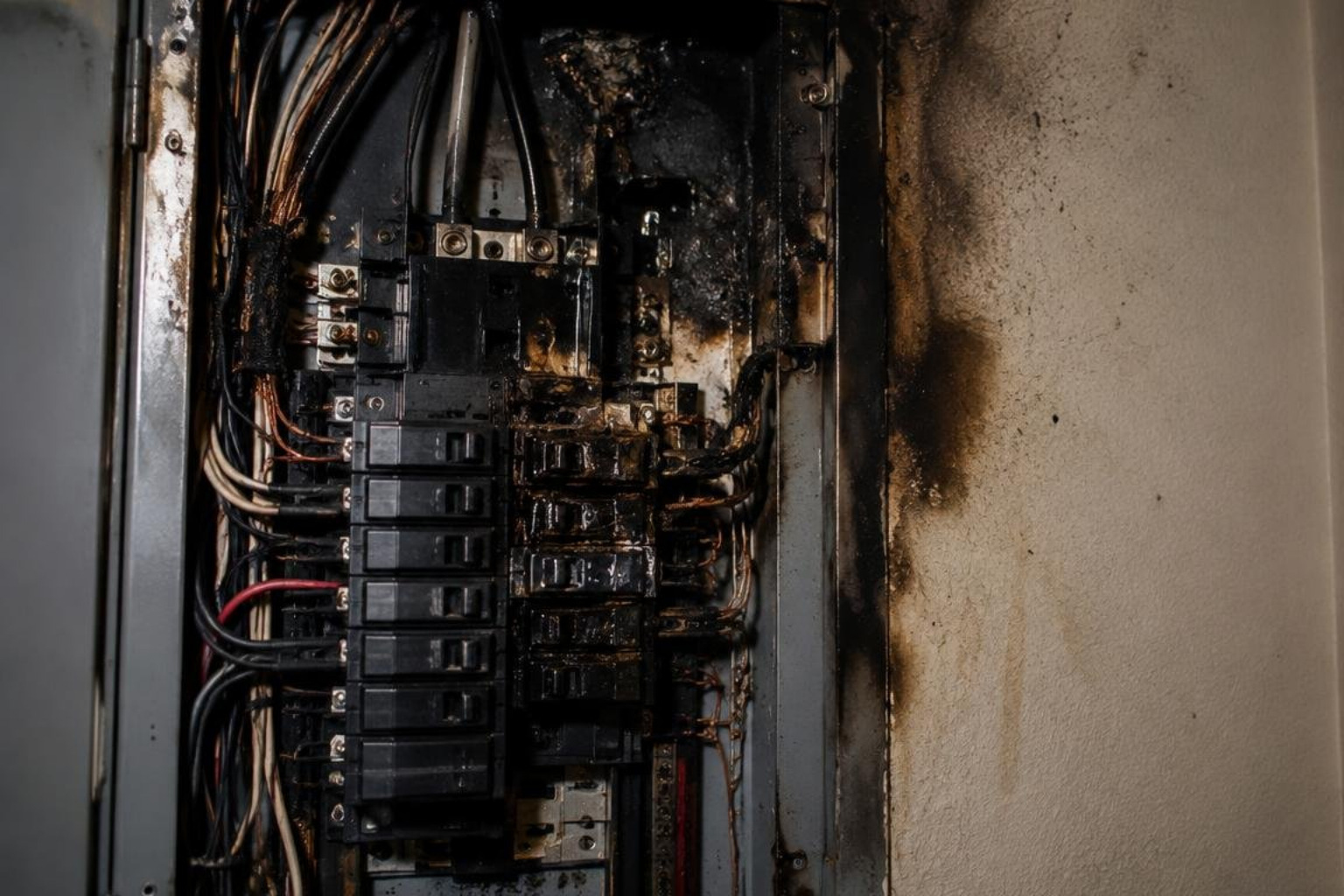
An electrical emergency is any situation where your home’s wiring, panel, or connected devices create an immediate risk of fire, electrocution, or severe property damage. Electricity is wonderfully convenient until it escapes its insulated pathways. When current arcs or overloads a circuit, temperatures escalate within seconds, turning combustible building materials, drywall paper, and wire sheathing into kindling.
Many homeowners I speak with across Raleigh, Cary, and Durham wonder whether their electrical issue warrants an immediate midnight service call or if it can wait until Monday morning. If you notice active physical hazards—such as scorch marks, burning odors, or unexplainable partial blackouts—the answer is always to seek immediate professional intervention.
Here is a quick checklist of severe electrical warning signs requiring immediate dispatch:
- Active arcing or visible sparking from any outlet, switch, or breaker panel.
- Persistent acrid or fishy burning smells emanating from walls, baseboards, or utility closets.
- Audible buzzing, humming, or sizzling behind drywall or inside the load center.
- Discolored, melted, or hot-to-the-touch outlet covers and switch plates.
- Sudden partial power loss where half your home loses electricity while your neighbors remain fully powered.
- Water contact with electrical infrastructure, including flooded basements or roof leaks dripping into panelboards.
- Exposed, frayed, or chewed live wiring accessible to occupants or pets.
Critical Warning Signs That Require Immediate Dispatch
Visible sparks and electrical smoke represent undeniable emergencies. If an outlet sparks when you plug in a refrigerator or you see thin wisps of smoke trailing from a switch plate, the copper contacts inside have likely loosened or shorted out. Loose electrical connections create micro-gaps. Electricity jumps across these gaps via an electrical arc, reaching temperatures exceeding several thousand degrees.
Pay close attention to your sense of smell. Overheating wire insulation, specifically modern polyvinyl chloride (PVC) and older rubberized coatings, produces a distinct chemical odor often described as burning plastic or rotting fish. If you trace that smell to a specific wall cavity or appliance connection, the wiring is actively melting.
Similarly, physical sensations tell a clear story. If you experience a tingling sensation or a direct shock when touching the metallic chassis of an oven, washing machine, or light switch, you are dealing with a dangerous ground fault. Current is energizing the exterior metal surfaces instead of flowing safely to earth ground. Persistent breaker trips that occur immediately upon resetting are another critical warning sign. The breaker is actively preventing a catastrophic wire melt down; forcing it to stay on or repeatedly resetting it bypasses that safety mechanism and invites disaster.
Dangerous Aging Infrastructure: Obsolete Panels and Wiring Risks
Homes built several decades ago in established neighborhoods throughout North Carolina were simply not designed to handle the heavy electrical loads of modern living. In older properties, we regularly encounter obsolete service equipment that poses inherent fire and failure hazards under stress.
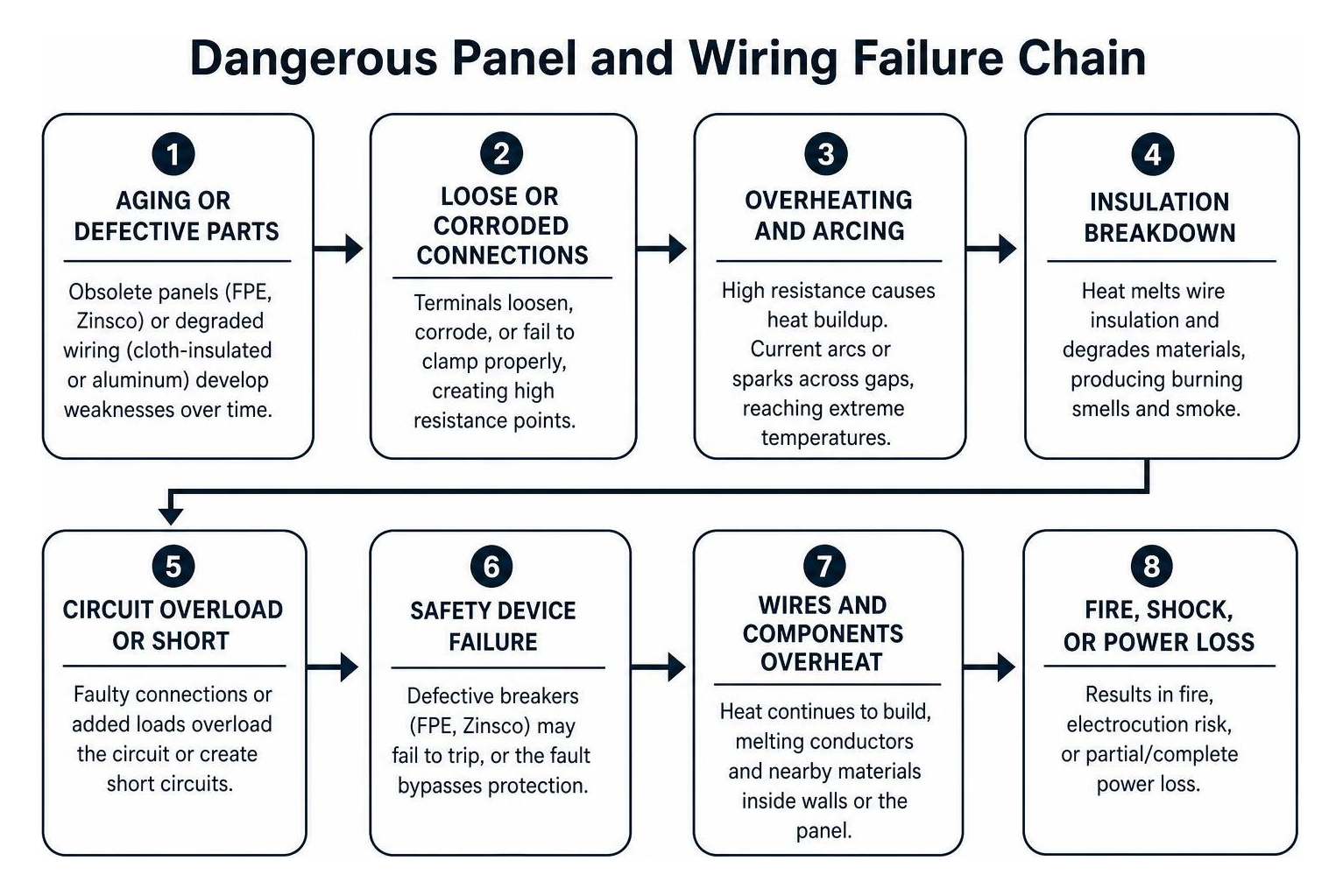
Among the most hazardous legacy installations are Federal Pacific Electric (FPE) Stab-Lok panels and Zinsco electrical boxes. Testing has demonstrated that FPE breakers frequently fail to trip during sustained overcurrent situations, effectively allowing circuits to overheat until the wire catches fire inside the walls. Zinsco panels suffer from a critical design flaw where the circuit breakers corrode and fuse directly to the aluminum bus bar, preventing the breaker from ever cutting power during an overload.
Beyond the breaker box, older branch circuit wiring presents substantial risks:
- Cloth-Insulated Wiring: Pre-1960s wiring uses fabric sheathing that becomes brittle and flakes away over time, leaving bare copper conductors exposed inside wall cavities.
- Degraded Aluminum Wiring: Used widely in the late 1960s and 1970s, aluminum expands and contracts significantly more than copper, leading to loose terminal connections, oxidation, and severe arcing at junction points.
- Backstabbed Push-In Connections: In many tract homes, builders pushed wires into the spring-loaded rear slots of switches and outlets rather than wrapping them around screw terminals. Over decades, these spring clips lose tension, resulting in high-resistance connections that overheat and burn.
Learning more about finding the right electrical contractor can help you plan a comprehensive system replacement before these obsolete components fail under load.
Critical Steps to Take While Waiting for an Emergency Electrician
The moments between discovering an electrical hazard and the arrival of a professional are critical for personal safety and property preservation. Taking calm, deliberate actions will drastically reduce the risk of house fires or electrical shock.
Safe Power Isolation and Hazard Containment Procedures
Your primary objective is to eliminate voltage to the compromised area without putting yourself in harm’s way.
- Assess the Panel Environment: Locate your main electrical service panel. Before touching it, inspect the floor around you. Never stand in standing water, damp concrete, or wet soil to operate a breaker box. If the floor is wet, or if the panel itself is actively buzzing, smoking, or sparking, do not touch it. Evacuate the property immediately and contact emergency authorities.
- Execute the Main Service Disconnect: If the area around the panel is completely dry and safe, open the panel door and flip the large Main Breaker (typically labeled 100A, 150A, or 200A at the top or bottom of the panel) firmly to the OFF position. This shuts down all power feeding the home’s branch circuits.
- Isolate Specific Branch Circuits: If the issue is isolated to a single smoking outlet and you can clearly identify its dedicated breaker, switch off that specific breaker. If you have any doubt whatsoever, shut off the entire main disconnect.
- Unplug Reachable Devices Safely: If safe to do so without touching discolored plastic or bare wires, unplug sensitive electronics and major appliances on the affected circuit to protect them from transient voltage spikes when power is eventually restored.
- Contain the Area: Keep children and household pets completely out of the room or utility area experiencing the fault. Close doors to contain potential smoke migration.
- Fire Safety Protocols: If active flames emerge from an outlet or appliance, evacuate everyone and dial 911 immediately. If you have an accessible, fully charged Class C dry chemical fire extinguisher, you may attempt to suppress small localized electrical flames. Never use water on an electrical fire, as water conducts electricity and will result in violent shock or electrocution.
What to Expect When Calling an Emergency Electrician for Urgent Repairs
When you call for urgent service, you will undergo a rapid phone triage with a live dispatcher. You will be asked to describe the visible symptoms, verify whether you have successfully isolated power at the main panel, and confirm whether there is water intrusion or smoke. This triage ensures that high-risk hazards receive priority routing.
Upon arrival, a licensed technician follows strict diagnostic workflows:
- Site Safety Isolation: The electrician confirms zero energy state across the affected circuits using non-contact voltage detectors and calibrated multimeters.
- Thermal Imaging Inspection: Utilizing infrared thermal cameras, technicians scan panels, junction boxes, and walls to detect hidden hotspots and thermal overloads invisible to the naked eye.
- Diagnostic Load & Continuity Testing: The technician tests circuit integrity, identifies direct shorts or ground faults, and checks for phase drops.
- Code Compliance Review: Repairs are executed according to modern national electrical codes and standard electrical safety certifications and regulations to guarantee the permanent safety of the branch circuit.
Environmental Triggers and Coastal Electrical Hazards
Severe weather patterns, localized storms, and humidity shifts create substantial stress on residential electrical systems. From coastal zones up through Piedmont communities like Apex, Wake Forest, and Garner, exterior electrical connections face constant environmental degradation.
Lightning Surges and Utility Grid Instability
A direct lightning strike is not necessary to cause catastrophic household damage. Nearby cloud-to-ground strikes induce immense electromagnetic pulses into overhead utility distribution lines. These surges generate transient high-voltage spikes reaching tens of thousands of volts, traveling instantly through your service drop and into your load center.
These sudden voltage surges can:
- Melt the internal contacts of circuit breakers, welding them shut.
- Vaporize delicate solid-state control boards on modern smart appliances.
- Blow out utility transformers, resulting in a “dropped leg of service” where your home receives only 120 volts across one phase instead of the standard 240-volt split-phase service.
When a home drops a leg of power, large 240V equipment—such as central air conditioners, heat pumps, and electric ranges—fails to operate correctly or buzzes loudly. If your cooling system behaves erratically following a lightning storm, addressing the underlying electrical delivery and scheduling specialized HVAC repair will prevent premature compressor burnout.
Water Intrusion and Corroded Outdoor Service Equipment
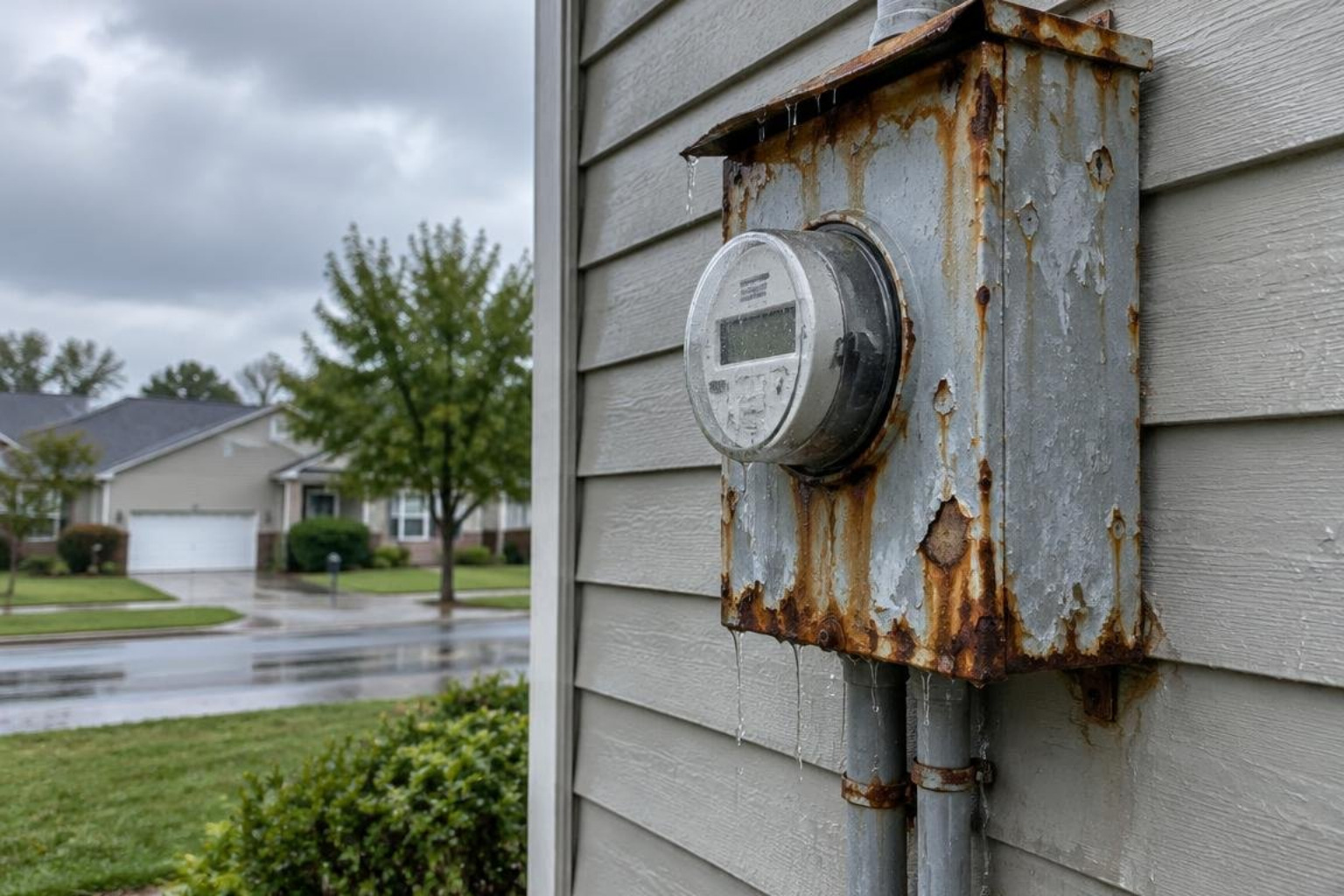
Outdoor electrical equipment is continually exposed to wind-driven rain, atmospheric moisture, and humidity. Over time, the weatherproof seals on the outdoor meter enclosure, service mast, and weatherhead can crack. Rainwater then seeps into the overhead conduit, running directly inside the cable jacket straight down into your indoor breaker panel.
Water inside a load center creates severe problems:
- Conductive Residue: Rainwater carries mineral impurities that leave conductive deposits across circuit breaker terminals, establishing tracking paths that lead to cross-phase arcing.
- Corroded Bus Bars: Copper and aluminum bus bars develop heavy oxidation, resulting in high-resistance hot spots that melt breaker casing clips.
- Ground Fault Hazards: Wet outlets and submerged crawlspace junction boxes trigger immediate ground faults, disabling safety switches and leaving equipment chassis energized.
If you utilize an outdoor backup generator during storm-induced utility blackouts, improper transfer switch maintenance can also lead to backfeeding risks and burned-out mechanical interlocks.
Upfront Pricing, Response Times, and After-Hours Rates
Calling an electrician outside standard business hours involves a distinct pricing structure. Because emergency electrical contractors must maintain round-the-clock staffing, fully equipped mobile dispatch units, and on-call technicians, emergency rates reflect the speed and immediacy of the response.
Typical Emergency Dispatch & Rate Structures
Emergency electrical dispatches typically arrive within 30 to 90 minutes, depending on traffic conditions, geographic coverage, and weather severity. Most reputable companies implement clear, transparent pricing models rather than variable surcharges.
| Service Tier | Dispatch Window | Typical Rate Multiplier | Minimum Labor Charge |
|---|---|---|---|
| Standard Business Hours (Mon–Fri, 8 AM–5 PM) | Scheduled or Same-Day | 1.0x Base Rate | 1 Hour Minimum |
| Evening / After-Hours (Mon–Fri, 5 PM–8 AM) | Immediate (30–90 min) | 1.5x to 2.0x Service Call Fee | 2 Hours Minimum |
| Weekends & Major Holidays | Immediate (30–90 min) | 2.0x Service Call Fee | 3 to 4 Hours Minimum |
The initial service fee typically covers the technician’s travel, rapid triage, and the first hour of diagnostic labor. If extensive replacement parts or secondary repairs are required, an authorized quote should always be presented to you before any tools begin modifying your system.
Diagnostic Procedures and Transparent Estimates
Professional emergency electrical repair is built on clear communication. A qualified technician will never perform repairs without first explaining the root cause of the failure and providing a written estimate.
Emergency repair vehicles function as mobile warehouses, carrying replacement circuit breakers (including standard, GFCI, and AFCI units), commercial-grade receptacles, heavy-gauge service entrance cables, and conduit fittings. This extensive mobile inventory enables technicians to achieve full resolution during a single late-night visit in the vast majority of cases. If municipal permitting is legally mandated for major structural panel replacements, licensed contractors utilize emergency permit provisions that allow immediate safety restorations with formal municipal filings submitted within 48 hours.
Why to Consult an Emergency Electrician Before Heavy Equipment Upgrades
When adding heavy-draw appliances to your home—such as commercial-style ranges, tankless water heaters, high-output laundry suites, or level-2 EV chargers—your existing electrical service must be evaluated for capacity.
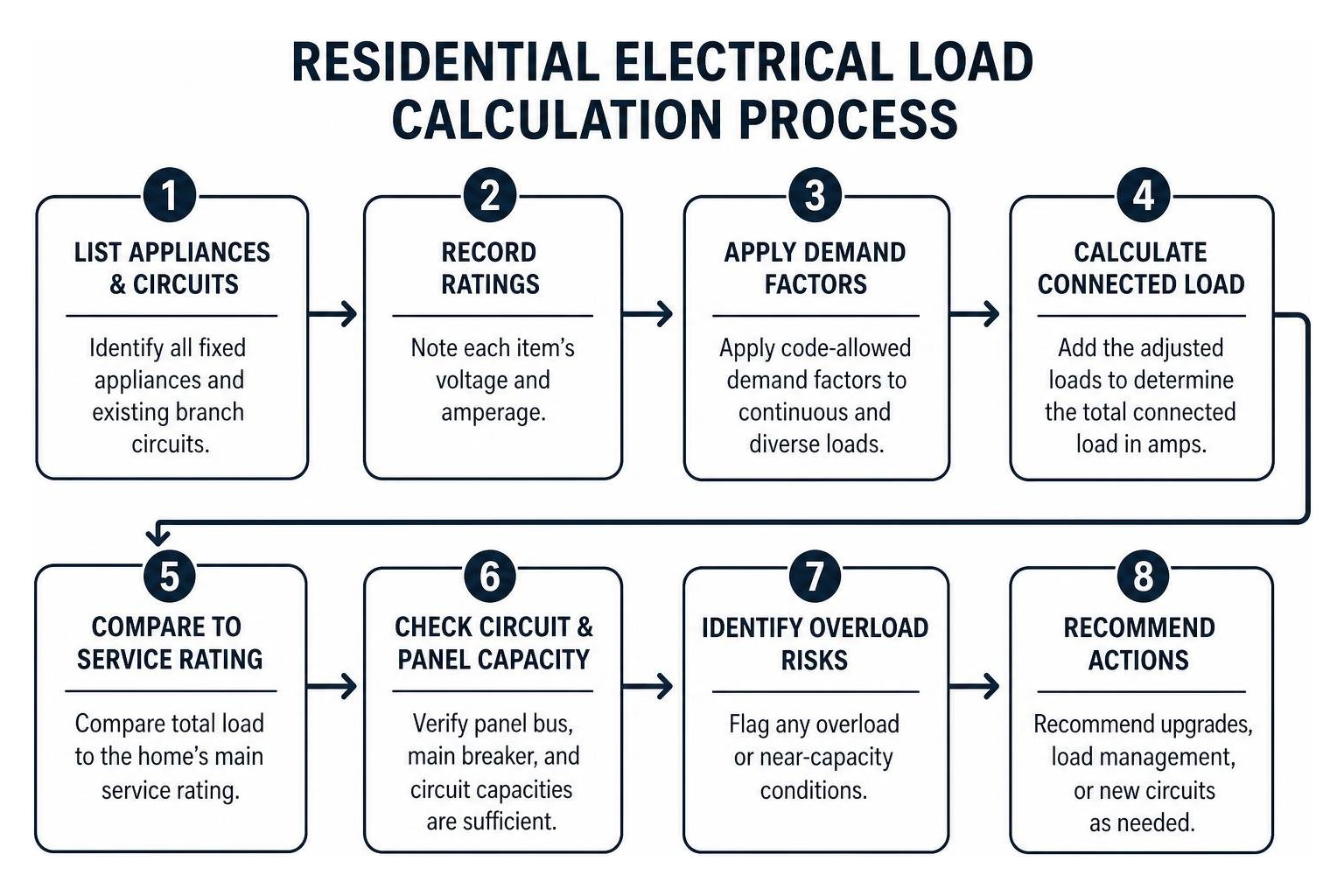
Connecting a 50-amp appliance to a panelboard that is already operating near its total rated amperage threshold will cause frequent main breaker tripping, severe heat buildup across the panel bus bar, and potential insulation breakdown. Before installing large domestic equipment, having a professional evaluate your panel’s dedicated 240V circuits and overall load calculation ensures safe operation. Coordinating this with professional appliance installation and removal protects both your warranty and your home’s electrical grid.
Preventive Maintenance and Long-Term System Upgrades
The most cost-effective electrical emergency is the one that never happens. Implementing proactive upgrades will safeguard your home against unforeseen wiring failures and high-voltage grid disruptions.
- Whole-House Surge Protective Devices (SPDs): Installed directly at your main load center, a Type 2 whole-home surge protector diverts large transient voltage spikes from lightning strikes and utility switching safely into the ground rod, shielding sensitive appliance microprocessors.
- Arc-Fault Circuit Interrupter (AFCI) Breakers: AFCI breakers detect unintended electrical arcing—the primary cause of electrical fires—and disconnect power before wire insulation ignites.
- Ground-Fault Circuit Interrupter (GFCI) Outlets: Essential in kitchens, bathrooms, garages, and outdoor locations, GFCIs cut power in milliseconds if current leakage is detected, eliminating electrocution hazards.
- Routine Thermal Panel Scanning: Having an electrician inspect your panel with infrared thermal imaging every few years identifies loose lugs and overheating breakers long before they emit smoke or spark.
Frequently Asked Questions About Emergency Electrical Services
Can I continuously reset a circuit breaker that keeps tripping?
No, you should never continuously reset a breaker that trips repeatedly. A circuit breaker is an essential safety device designed to trip when it detects an excessive current load, a direct short circuit, or a ground fault. If you reset the breaker and it clicks off immediately or trips again shortly after, an active fault is present. Continuously forcing the switch back to the “ON” position forces current through compromised wiring, which can cause internal arcing, melt wire insulation inside your walls, and trigger an electrical structure fire. Turn the breaker off and leave it off until a licensed professional evaluates the circuit.
What is the difference between an emergency electrician call and an electric utility outage?
An electric utility outage occurs when the external power grid fails, affecting entire neighborhoods, city blocks, or distribution corridors due to downed high-voltage lines, blown substation transformers, or severe storms. In this scenario, your utility provider is solely responsible for restoring service. An emergency electrician call is required when the issue is confined strictly to your private property. The utility company is only responsible for delivering power up to the service point (the connection at your weatherhead or electric meter). Everything from the meter enclosure, service mast, main breaker panel, and internal branch circuits belongs to the homeowner and requires a private, licensed electrical contractor for repairs.
How do after-hours emergency rates and dispatch times work?
After-hours emergency electrical services operate 24/7 to address urgent safety hazards outside regular business hours, including nights, weekends, and holidays. Because technicians are dispatched on demand with fully equipped service vehicles, after-hours calls generally utilize a premium rate structure. This often includes a 1.5x to 2x multiplier on standard service-call fees and a mandatory minimum labor charge of 2 to 4 hours. Dispatch windows typically range from 30 to 90 minutes. The emergency rate covers rapid telephone triage, travel, diagnostic testing with specialized tools, and immediate safety stabilization of the hazard.
Conclusion
Electrical emergencies are unpredictable, high-stakes events that demand swift action, calm prioritization, and certified expertise. Whether you are dealing with a buzzing breaker box, an acrid burning smell behind a kitchen wall, or severe storm surge damage, recognizing the early warning signs and shutting off power at the main breaker can save your property from catastrophic fire and protect your family from severe shock hazards.
Never attempt dangerous DIY repairs on energized electrical components or obsolete panels. Ensuring your home has dedicated appliance circuits, functional surge suppressors, and modern circuit protection provides long-term peace of mind. For ongoing residential needs or commercial facility support, explore our specialized commercial appliance repair services to keep your heavy-duty equipment running efficiently. If you suspect an electrical problem has damaged your major household appliances, please contact our repair team at iFix Appliances today for honest diagnostics, comprehensive repairs, and dependable customer service.



0 Comments